Blantyre, Malawi
Saying the final goodbyes was difficult. One of our research supervisors who is Malawian placed his head on my shoulder and said “I have no words”. I had no words either. I just hugged him and said “It’s alright; we will see each other again.” The friendships and collegial relationships that developed over the past 3 weeks are amazing. I worked very closely with the Malawi and US research team members just about every day since we arrived 3 weeks ago.
I am 33,000 feet in the air leaving the beautiful country of Malawi on the first leg of my journey home. It has been an amazing experience and I am grateful for the opportunity to conduct this research project on such an incredible health crisis tropic and to learn more about traditional healers—such an interesting group of health care providers in Africa.
Monday, July 28, 2008

Saturday, July 26, 2008
Singing, Dancing, and Preaching at the Pentecostal Church
Chimwankhunda, Malawi
Our morning began early as we set out to attend a 7:30 a.m. service at the Living Waters Church (Pentecostal) in Chimwankhunda. This faith-based organization is one of the five religious groups in our study. Religious organizations are a large part of the lives of Malawians, and it has been an honor to witness the various church services these past three weeks.
When we arrived we found out that an earlier service had started at 6 a.m. We waited outside for the next service scheduled to begin at 8 a.m. The service activities were lively, and the service lasted for almost 3 hours! It was indeed a physical and spiritual workout. There is a lovely young adult choir that stood on its feet most of the service and a lovely women’s choir that delivered soulful songs. There is something about African a cappella singing – it’s hard to describe but the tone is deep and rich and you feel transported back to earlier times. I can just imagine my ancestors singing stories to the village community or teaching songs to young children. There was lively singing, dancing, hand clapping, speaking in tongues, and preaching – all the things I remembered about the Pentecostal services I attended as a child. Malawians are serious about their faith, and the church is a strong influential power and plays a critical role in disseminating information and education about HIV/AIDS to local members. I shall never forget this service. I had heard so much about the church and I’m glad I was able to visit.
The afternoon was spent packing and reflecting more on the past three weeks. At this time my feelings are mixed. I am ready to return home, and I am missing my new friends who I’ve met in Malawi.
Our morning began early as we set out to attend a 7:30 a.m. service at the Living Waters Church (Pentecostal) in Chimwankhunda. This faith-based organization is one of the five religious groups in our study. Religious organizations are a large part of the lives of Malawians, and it has been an honor to witness the various church services these past three weeks.
When we arrived we found out that an earlier service had started at 6 a.m. We waited outside for the next service scheduled to begin at 8 a.m. The service activities were lively, and the service lasted for almost 3 hours! It was indeed a physical and spiritual workout. There is a lovely young adult choir that stood on its feet most of the service and a lovely women’s choir that delivered soulful songs. There is something about African a cappella singing – it’s hard to describe but the tone is deep and rich and you feel transported back to earlier times. I can just imagine my ancestors singing stories to the village community or teaching songs to young children. There was lively singing, dancing, hand clapping, speaking in tongues, and preaching – all the things I remembered about the Pentecostal services I attended as a child. Malawians are serious about their faith, and the church is a strong influential power and plays a critical role in disseminating information and education about HIV/AIDS to local members. I shall never forget this service. I had heard so much about the church and I’m glad I was able to visit.
The afternoon was spent packing and reflecting more on the past three weeks. At this time my feelings are mixed. I am ready to return home, and I am missing my new friends who I’ve met in Malawi.
Getting Ready to Leave Malawi
Limbe, Malawi
The process of saying farewell to members of the research team has begun. The past 3 weeks have passed quickly, and we have completed an incredible amount of work. For me, today was the most restful day of the entire trip. I typed a transcript and some field notes but most of the day I just rested and began to pack my bags for home. There are three of us left, and we spent the time putting the final touches to the remaining work to be conducted by the Malawi research team for the rest of the year. For my project I have interview transcripts that have to be translated into English and typed, which is not an easy task, but I am confident that our research assistants will do a stellar job!
The process of saying farewell to members of the research team has begun. The past 3 weeks have passed quickly, and we have completed an incredible amount of work. For me, today was the most restful day of the entire trip. I typed a transcript and some field notes but most of the day I just rested and began to pack my bags for home. There are three of us left, and we spent the time putting the final touches to the remaining work to be conducted by the Malawi research team for the rest of the year. For my project I have interview transcripts that have to be translated into English and typed, which is not an easy task, but I am confident that our research assistants will do a stellar job!
Friday, July 25, 2008
Celebrating with Roasted Goat, Fanta, Dance
Limbe, Malawi
Today is clean-up day to make sure we have all of our documents on the various computers before we leave for home. I still have interviews to conduct next year, but the plan is to analyze what we have and possibly then modify our questions based on our preliminary data analysis. We have completed most of our interviews of religious leaders and adults living with HIV/AIDS.
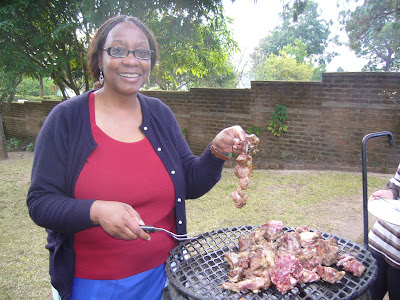
We had our celebration party today with our Malawian research team members. A good time was had by all, although it was bittersweet. Eating, drinking Fanta sodas, and dancing. I’ve been craving roasted goat since I arrived in Malawi and today my craving was satisfied. I even had the honor of roasting the meat. Yum! Yum!
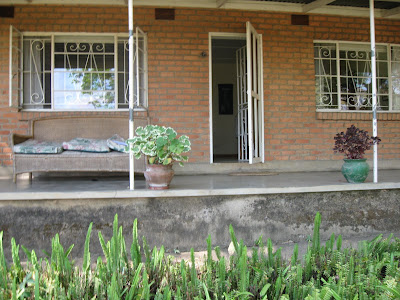
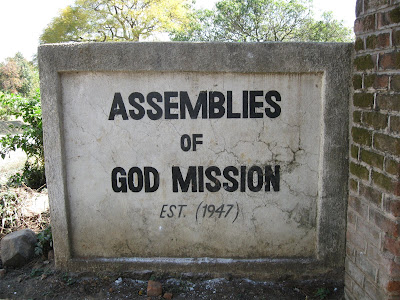
Today is clean-up day to make sure we have all of our documents on the various computers before we leave for home. I still have interviews to conduct next year, but the plan is to analyze what we have and possibly then modify our questions based on our preliminary data analysis. We have completed most of our interviews of religious leaders and adults living with HIV/AIDS.
Me grilling goat meat
House where I lived while conducting my research. It was in the Assemblies of God Mission
Assembies of God Mission sign
Thursday, July 24, 2008
The Weaving Factory in Limbe
Limbe, Malwi
Today I typed up a traditional healer transcript that contained a lot of interesting data to process and reflect on. Most of the research team is out today conducting interviews, and the rest of us stayed behind to catch up on our paper work.
During the late morning I paid a visit to the Weaving Factory in Limbe. This is a terrific place. Eighty percent of the employees have some kind of physical disability. This includes being blind, deaf, mute, or have difficulty walking. With their other senses the factory workers are able to create beautiful rugs, place mats, screen printing of T-shirts, dresses, and all kinds of gorgeous products. They spin their own yarn, dye the yarn, and then weave it into rugs, mats, purses, whatever, right on the premises. It was a sight to behold.
Today I typed up a traditional healer transcript that contained a lot of interesting data to process and reflect on. Most of the research team is out today conducting interviews, and the rest of us stayed behind to catch up on our paper work.
During the late morning I paid a visit to the Weaving Factory in Limbe. This is a terrific place. Eighty percent of the employees have some kind of physical disability. This includes being blind, deaf, mute, or have difficulty walking. With their other senses the factory workers are able to create beautiful rugs, place mats, screen printing of T-shirts, dresses, and all kinds of gorgeous products. They spin their own yarn, dye the yarn, and then weave it into rugs, mats, purses, whatever, right on the premises. It was a sight to behold.
Wednesday, July 23, 2008
Who Are These Strangers?
Mulanje and Loundu, Malawi
Mulanje is one of the most beautiful places that I have seen in Malawi. I’ve visited Lake Malawi, which is beautiful, but this area with the famous Mount Mulanje was just breath taking. This region is the home of the tea plantations, so please imagine a green carpet (tea bushes) extending from the road up to the base of the mountains. The tea plants give off various shades of green depending on how the sun reflects back from the majestic slopes. In the distance you can see the tea pickers gathering the harvest with their baskets and tea leave clippers.
We passed the tea factory the employs a lot of Malawians; every morning at the research headquarters for breakfast and during the day we drink the popular Chombe tea, which is grown in Mulanje. When I return to Mulanje I plan to hike up the mountain – I have an entire year to get in shape for that.
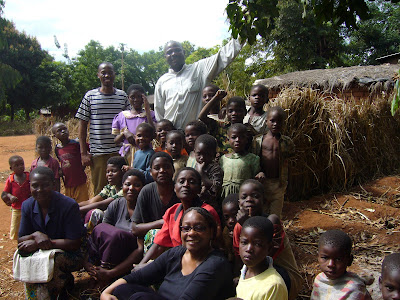
Today’s business included interviewing two traditional healers. This is exciting because these are healers from rural villages. Once we were at the main entrance of the village we had to walk about a quarter of a mile to reach our first respondent in Mabuka Village. We met the chief of the village, who is a woman, and per protocol we greeted the village chief and explained to her the purpose of our visit. She was very kind, gracious, and welcoming. I was curious about how she became the chief of the village, and I was told she inherited the position from her uncle. This was surprising to me as we often assume that positions are inherited from parents, but not in this case.
The traditional healer who we met was very warm and open, and the interview went well. We met his wife and a few of his children. The village was very peaceful and serene. The children are running about playing, and they are always very curious when visitors are present.
We then went off to Loundu Village to meet another traditional healer. He welcomed us and invited us to enter his house. He was very gracious and permitted us take photos of his traditional medicine collection, which included herbs, leaves, dried roots, and tree bark. I don’t have names of these medicines but some of the names in Chichewa might come out in the interviews. As we waited outside while the interview was conducted in his house, the children gathered looking as if to ask – “who are these strangers?” The scenic views were spectacular, and there was a wonderful sense of calm and peace in the village.
I am grateful to Alice who is a GAIA regional director, and Edna who is a GAIA village coordinator, for arranging the interviews. Their assistance in this process is what makes our international research efforts successful!
Mulanje is one of the most beautiful places that I have seen in Malawi. I’ve visited Lake Malawi, which is beautiful, but this area with the famous Mount Mulanje was just breath taking. This region is the home of the tea plantations, so please imagine a green carpet (tea bushes) extending from the road up to the base of the mountains. The tea plants give off various shades of green depending on how the sun reflects back from the majestic slopes. In the distance you can see the tea pickers gathering the harvest with their baskets and tea leave clippers.
We passed the tea factory the employs a lot of Malawians; every morning at the research headquarters for breakfast and during the day we drink the popular Chombe tea, which is grown in Mulanje. When I return to Mulanje I plan to hike up the mountain – I have an entire year to get in shape for that.
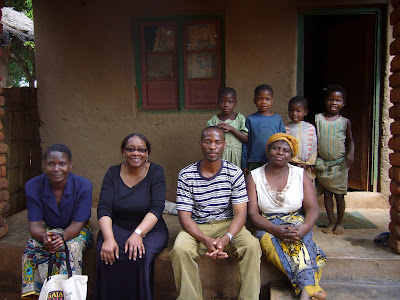
Me (front row, sitting) with villagers from Mambuka where we interviewed a traditonal healer
The traditional healer who we met was very warm and open, and the interview went well. We met his wife and a few of his children. The village was very peaceful and serene. The children are running about playing, and they are always very curious when visitors are present.
We then went off to Loundu Village to meet another traditional healer. He welcomed us and invited us to enter his house. He was very gracious and permitted us take photos of his traditional medicine collection, which included herbs, leaves, dried roots, and tree bark. I don’t have names of these medicines but some of the names in Chichewa might come out in the interviews. As we waited outside while the interview was conducted in his house, the children gathered looking as if to ask – “who are these strangers?” The scenic views were spectacular, and there was a wonderful sense of calm and peace in the village.
Edna (GAIA coordinator), me, Edgar, and the Chief woman of the village (left to right) with beautiful village children.
Tuesday, July 22, 2008
The Final Stretch
Limbe, Malawi
The research “train” is pulling into the final stretch of our last week here in Malawi. The discussions today with the research team focused on the next steps for the summer and next year for the current project and future projects for which we are awaiting funding. Everyone is busy transcribing interviews from Chichewa into English and then typing the interviews for analysis. We have interviews schedule tomorrow with traditional healers in rural areas.
The time has passed very quickly, but I am thrilled at how productive the data collection has been. We are treading new waters with exploring our sample of traditional healers; the support of the research team with this process has exceeded my expectations!
The research “train” is pulling into the final stretch of our last week here in Malawi. The discussions today with the research team focused on the next steps for the summer and next year for the current project and future projects for which we are awaiting funding. Everyone is busy transcribing interviews from Chichewa into English and then typing the interviews for analysis. We have interviews schedule tomorrow with traditional healers in rural areas.
The time has passed very quickly, but I am thrilled at how productive the data collection has been. We are treading new waters with exploring our sample of traditional healers; the support of the research team with this process has exceeded my expectations!
Subscribe to:
Posts (Atom)


 Posts
Posts

