A Traditonal Healer sitting on the rock with an extended hand speaking with two Msulim Leaders and an Anglican Theology Professor.
Thursday, October 29, 2009
Christian & Muslim Leaders Conference - Zomba 10/20/09
This event had enormous possibilities as the research team wanted to share with them what we found in terms of how the religious organizations work to provide care for those who are HIV positive and their families and what strategies can be used to reduce the incidence of HIV/AIDS – especially in woman and children. The group included Christian and Muslim Religious leaders and of course the GAIA/UCSF Research Team.
Overall the program went very well – there are always a few unknowns but the group was engaged, participatory, and committed to the cause. The first session of the morning session covered the overview of the general study findings in terms of the demographics of the study participants which included central and local religious leaders and interviews with people who were HIV positive.
The second session covered had a justice theme if discussing women and their role in religious organizations and how religious organizations view the role of women. Theme was the injustice of treating women like second class citizens and how the oppression places women at risk for contracting HIV.
Next, Dr .Susan Kools presented her findings on youth and what they reported about HIV/AIDS prevention. The take home message to the group was that youth needed constructive activities that would occupy their time and that communication with adults that they trusted would allow them to get accurate information and their sexuality and HIV/AIDS. The participants were then divided into small groups to discuss ideas for strategies to help women and youth and instructed to report their recommendations after lunch.
My portion of the program was very exciting for me and involved a controversial topic. I moderated a panel with a traditional healer and a religious leader and the goal was to discuss how religious leaders and traditional healers can come together to assist people who have HIV/AIDS and their families. I must admit that I was a bit nervous myself because my findings of the initial interview were mixed in terms of traditional healers having any collaboration with religious leaders.
At the beginning of the session I shared with the group the preliminary findings from interviewing traditional healers last summer. The group was mixed with those from Christian and Muslims and one of the interviewees was a woman. The general research findings related to the current relationship between the traditional healers and religious leaders was mixed. Some traditional healers said that they had no contact with religious leaders and that the church preached against them and others said that they had been invited by their pastor or priest to provided presentations to the congregations on the topic of HIV/AIDS. One interesting point that the panelist made who was a traditional healer was that even though religious leaders may encourage their members to not seek out a traditional healer, the religious leaders do seek out the help of traditional healers, but in secret.
At the onset of the discussion the traditional healer was a very eloquent and articulate young man. He shared up front that he was a bit anxious about his being at the conference and was not quite sure of his role in discussing this topic. He spoke of the misconceptions and negative stereotypes that people have about traditional healers. The religious leader was open and honest about the myths people harbor about traditional healers. The discussion was very interesting and lively as the two panelists stressed the importance of both groups participating in the fight against HIV AIDS. The audience was very engaged although we had only a few minutes for questions. My sense is that religious leaders have strong opinions about the use of traditional healers and that there are a lot of misconceptions and misunderstandings. Traditional healers, witch doctors, spiritual healers, those who practice “black magic” are all regarded as one group or one in the same and this is not true.
The take home message from the traditional healer was that the fact that you are a traditional healer does not mean that you do not have faith or that you do not believe in God. The take home message from the religious leader was that because you use the services of a traditional healer does not mean that you have lost your faith or have turned away from God. For me personally that was a profound moment. Both panelists agreed that the two groups must work together in the effort to combat the HIV/AIDS crisis in Malawi.
It will be interesting to see what other research questions emerge from this experience. We were to have a person who has HIV to be part of the panel but that did not happen. We do have one for the Friday conference and I know their presence will make a dynamic difference for the conversation.
The afternoon concluded with group presentations on their strategies to help youth and women and with a presentation by Rev. Donald Schell on best practices that were identified through the research process.
It was indeed a very good day.
Overall the program went very well – there are always a few unknowns but the group was engaged, participatory, and committed to the cause. The first session of the morning session covered the overview of the general study findings in terms of the demographics of the study participants which included central and local religious leaders and interviews with people who were HIV positive.
The second session covered had a justice theme if discussing women and their role in religious organizations and how religious organizations view the role of women. Theme was the injustice of treating women like second class citizens and how the oppression places women at risk for contracting HIV.
Next, Dr .Susan Kools presented her findings on youth and what they reported about HIV/AIDS prevention. The take home message to the group was that youth needed constructive activities that would occupy their time and that communication with adults that they trusted would allow them to get accurate information and their sexuality and HIV/AIDS. The participants were then divided into small groups to discuss ideas for strategies to help women and youth and instructed to report their recommendations after lunch.
My portion of the program was very exciting for me and involved a controversial topic. I moderated a panel with a traditional healer and a religious leader and the goal was to discuss how religious leaders and traditional healers can come together to assist people who have HIV/AIDS and their families. I must admit that I was a bit nervous myself because my findings of the initial interview were mixed in terms of traditional healers having any collaboration with religious leaders.
At the beginning of the session I shared with the group the preliminary findings from interviewing traditional healers last summer. The group was mixed with those from Christian and Muslims and one of the interviewees was a woman. The general research findings related to the current relationship between the traditional healers and religious leaders was mixed. Some traditional healers said that they had no contact with religious leaders and that the church preached against them and others said that they had been invited by their pastor or priest to provided presentations to the congregations on the topic of HIV/AIDS. One interesting point that the panelist made who was a traditional healer was that even though religious leaders may encourage their members to not seek out a traditional healer, the religious leaders do seek out the help of traditional healers, but in secret.
At the onset of the discussion the traditional healer was a very eloquent and articulate young man. He shared up front that he was a bit anxious about his being at the conference and was not quite sure of his role in discussing this topic. He spoke of the misconceptions and negative stereotypes that people have about traditional healers. The religious leader was open and honest about the myths people harbor about traditional healers. The discussion was very interesting and lively as the two panelists stressed the importance of both groups participating in the fight against HIV AIDS. The audience was very engaged although we had only a few minutes for questions. My sense is that religious leaders have strong opinions about the use of traditional healers and that there are a lot of misconceptions and misunderstandings. Traditional healers, witch doctors, spiritual healers, those who practice “black magic” are all regarded as one group or one in the same and this is not true.
The take home message from the traditional healer was that the fact that you are a traditional healer does not mean that you do not have faith or that you do not believe in God. The take home message from the religious leader was that because you use the services of a traditional healer does not mean that you have lost your faith or have turned away from God. For me personally that was a profound moment. Both panelists agreed that the two groups must work together in the effort to combat the HIV/AIDS crisis in Malawi.
It will be interesting to see what other research questions emerge from this experience. We were to have a person who has HIV to be part of the panel but that did not happen. We do have one for the Friday conference and I know their presence will make a dynamic difference for the conversation.
The afternoon concluded with group presentations on their strategies to help youth and women and with a presentation by Rev. Donald Schell on best practices that were identified through the research process.
It was indeed a very good day.
Thursday, October 22, 2009
Conference Location – Annie’s Lodge (10/19/09)
One and a half hours north of Blantyre is the town of Zomba. This is the location of our first conference entitled “Response to HIV/AIDS by Religious Leaders”. The purpose of the conference is to present to the group the findings of Dr. Sally Rankin’s large study examining how faith-based organizations are responding to the HIV/AIDS crisis in Malawi. The lodging area was quite spectacular. It looked and felt like a tropical garden paradise. I was amazed by the sheer beauty and it truly provided an open and welcoming environment for the conference proceedings. The research team is looking forward to not only sharing what we learned from our interviews, but also learning from our Malawian colleagues.
Monday, October 19, 2009
My Return to Malawi - Part 2
It is hard to believe that 15 months have passed since I left Malawi in July 2008 having completed the first stage of the research effort. The past months have been spent having interviews translated into English, reading the hundreds of lines of dialogue, and dealing with computer malfunctions. On the flip side I have had a wonderful time reading, analyzing, and thinking about what the religious leaders, traditional healers, and people living with HIV/AIDS had to say about the current crisis.
The trip to Africa is a long one, but was made easier by my discovery of the wonderful international airline Emirates. (I highly recommend it!) The first leg of the trip was 15 hours from San Francisco to Dubai and it was the longest flight I had been on to date. Once I landed in Malawi, being the social animal that I am, it is wonderful to see the familiar faces of my Malawi friends and colleagues with whom I will be connected to forever.
The main purpose of the return trip is to present the research project findings at two clergy conferences, one in Zomba and the other in Blantyre. As you may recall Dr. Sally Rankin from the School of Nursing is the Principal Investigator of the NIH R01 grant examining how faith-based organizations are addressing the HIV/AIDS crisis in Malawi and she is my mentor on my diversity supplement grant. My role at the conference will be to moderate a panel that includes a religious leader, a traditional healer, and an individual who is HIV positive. The topic to be discussed is how can religious leaders and traditional healers come together to help those who are living with HIV/AIDS and their families. In addition we are collecting interviews from 10 more traditional healers.
This is part two of the journey and I am confident that it will an interesting and rewarding experience.
The trip to Africa is a long one, but was made easier by my discovery of the wonderful international airline Emirates. (I highly recommend it!) The first leg of the trip was 15 hours from San Francisco to Dubai and it was the longest flight I had been on to date. Once I landed in Malawi, being the social animal that I am, it is wonderful to see the familiar faces of my Malawi friends and colleagues with whom I will be connected to forever.
The main purpose of the return trip is to present the research project findings at two clergy conferences, one in Zomba and the other in Blantyre. As you may recall Dr. Sally Rankin from the School of Nursing is the Principal Investigator of the NIH R01 grant examining how faith-based organizations are addressing the HIV/AIDS crisis in Malawi and she is my mentor on my diversity supplement grant. My role at the conference will be to moderate a panel that includes a religious leader, a traditional healer, and an individual who is HIV positive. The topic to be discussed is how can religious leaders and traditional healers come together to help those who are living with HIV/AIDS and their families. In addition we are collecting interviews from 10 more traditional healers.
This is part two of the journey and I am confident that it will an interesting and rewarding experience.
Tuesday, July 29, 2008
Thanks to All
Frankfurt, Germany
The final leg – I’m so happy to be going home to see my husband and return to work. There are many people I need to thank for this incredible experience. I must give many thanks to – God, my husband Ron, family, church family, friends, and colleagues. I appreciate your unwavering support and prayers. It will take me a while to process all that has transpired this past month. I am very blessed and I look forward with great enthusiasm what the future will bring and the results of the project.
Thanks to Susan Levings and Eric Davila who have organized and developed the blog site. They have done an outstanding job. This is a wonderful and creative way to share my experiences with the local community and the world. The feedback from readers has been sensational.
Finally I want to say a very special to Dr. Sally Rankin, who without, this project would not be. I thank her for her mentorship and guidance during this process.
It’s 12 noon, I’m back in San Francisco, and Ron is on his way to pick me up. Truly there is no place like home!
The final leg – I’m so happy to be going home to see my husband and return to work. There are many people I need to thank for this incredible experience. I must give many thanks to – God, my husband Ron, family, church family, friends, and colleagues. I appreciate your unwavering support and prayers. It will take me a while to process all that has transpired this past month. I am very blessed and I look forward with great enthusiasm what the future will bring and the results of the project.
Thanks to Susan Levings and Eric Davila who have organized and developed the blog site. They have done an outstanding job. This is a wonderful and creative way to share my experiences with the local community and the world. The feedback from readers has been sensational.
Finally I want to say a very special to Dr. Sally Rankin, who without, this project would not be. I thank her for her mentorship and guidance during this process.
It’s 12 noon, I’m back in San Francisco, and Ron is on his way to pick me up. Truly there is no place like home!
Monday, July 28, 2008
On My Way Home
Johannesburg, South Africa
Leg two of the trip. The 11 hour flight is hard but I am getting more exciting about getting closer to home. Next stop is Frankfurt, Germany.
Saying Goodbye
Blantyre, Malawi
Saying the final goodbyes was difficult. One of our research supervisors who is Malawian placed his head on my shoulder and said “I have no words”. I had no words either. I just hugged him and said “It’s alright; we will see each other again.” The friendships and collegial relationships that developed over the past 3 weeks are amazing. I worked very closely with the Malawi and US research team members just about every day since we arrived 3 weeks ago.
I am 33,000 feet in the air leaving the beautiful country of Malawi on the first leg of my journey home. It has been an amazing experience and I am grateful for the opportunity to conduct this research project on such an incredible health crisis tropic and to learn more about traditional healers—such an interesting group of health care providers in Africa.
Saying the final goodbyes was difficult. One of our research supervisors who is Malawian placed his head on my shoulder and said “I have no words”. I had no words either. I just hugged him and said “It’s alright; we will see each other again.” The friendships and collegial relationships that developed over the past 3 weeks are amazing. I worked very closely with the Malawi and US research team members just about every day since we arrived 3 weeks ago.
I am 33,000 feet in the air leaving the beautiful country of Malawi on the first leg of my journey home. It has been an amazing experience and I am grateful for the opportunity to conduct this research project on such an incredible health crisis tropic and to learn more about traditional healers—such an interesting group of health care providers in Africa.
Saturday, July 26, 2008
Singing, Dancing, and Preaching at the Pentecostal Church
Chimwankhunda, Malawi
Our morning began early as we set out to attend a 7:30 a.m. service at the Living Waters Church (Pentecostal) in Chimwankhunda. This faith-based organization is one of the five religious groups in our study. Religious organizations are a large part of the lives of Malawians, and it has been an honor to witness the various church services these past three weeks.
When we arrived we found out that an earlier service had started at 6 a.m. We waited outside for the next service scheduled to begin at 8 a.m. The service activities were lively, and the service lasted for almost 3 hours! It was indeed a physical and spiritual workout. There is a lovely young adult choir that stood on its feet most of the service and a lovely women’s choir that delivered soulful songs. There is something about African a cappella singing – it’s hard to describe but the tone is deep and rich and you feel transported back to earlier times. I can just imagine my ancestors singing stories to the village community or teaching songs to young children. There was lively singing, dancing, hand clapping, speaking in tongues, and preaching – all the things I remembered about the Pentecostal services I attended as a child. Malawians are serious about their faith, and the church is a strong influential power and plays a critical role in disseminating information and education about HIV/AIDS to local members. I shall never forget this service. I had heard so much about the church and I’m glad I was able to visit.
The afternoon was spent packing and reflecting more on the past three weeks. At this time my feelings are mixed. I am ready to return home, and I am missing my new friends who I’ve met in Malawi.
Our morning began early as we set out to attend a 7:30 a.m. service at the Living Waters Church (Pentecostal) in Chimwankhunda. This faith-based organization is one of the five religious groups in our study. Religious organizations are a large part of the lives of Malawians, and it has been an honor to witness the various church services these past three weeks.
When we arrived we found out that an earlier service had started at 6 a.m. We waited outside for the next service scheduled to begin at 8 a.m. The service activities were lively, and the service lasted for almost 3 hours! It was indeed a physical and spiritual workout. There is a lovely young adult choir that stood on its feet most of the service and a lovely women’s choir that delivered soulful songs. There is something about African a cappella singing – it’s hard to describe but the tone is deep and rich and you feel transported back to earlier times. I can just imagine my ancestors singing stories to the village community or teaching songs to young children. There was lively singing, dancing, hand clapping, speaking in tongues, and preaching – all the things I remembered about the Pentecostal services I attended as a child. Malawians are serious about their faith, and the church is a strong influential power and plays a critical role in disseminating information and education about HIV/AIDS to local members. I shall never forget this service. I had heard so much about the church and I’m glad I was able to visit.
The afternoon was spent packing and reflecting more on the past three weeks. At this time my feelings are mixed. I am ready to return home, and I am missing my new friends who I’ve met in Malawi.
Getting Ready to Leave Malawi
Limbe, Malawi
The process of saying farewell to members of the research team has begun. The past 3 weeks have passed quickly, and we have completed an incredible amount of work. For me, today was the most restful day of the entire trip. I typed a transcript and some field notes but most of the day I just rested and began to pack my bags for home. There are three of us left, and we spent the time putting the final touches to the remaining work to be conducted by the Malawi research team for the rest of the year. For my project I have interview transcripts that have to be translated into English and typed, which is not an easy task, but I am confident that our research assistants will do a stellar job!
Friday, July 25, 2008
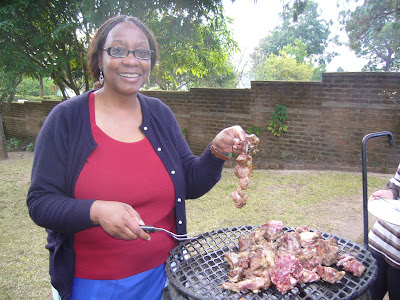
Celebrating with Roasted Goat, Fanta, Dance
Limbe, Malawi
Today is clean-up day to make sure we have all of our documents on the various computers before we leave for home. I still have interviews to conduct next year, but the plan is to analyze what we have and possibly then modify our questions based on our preliminary data analysis. We have completed most of our interviews of religious leaders and adults living with HIV/AIDS.
We had our celebration party today with our Malawian research team members. A good time was had by all, although it was bittersweet. Eating, drinking Fanta sodas, and dancing. I’ve been craving roasted goat since I arrived in Malawi and today my craving was satisfied. I even had the honor of roasting the meat. Yum! Yum!
Today is clean-up day to make sure we have all of our documents on the various computers before we leave for home. I still have interviews to conduct next year, but the plan is to analyze what we have and possibly then modify our questions based on our preliminary data analysis. We have completed most of our interviews of religious leaders and adults living with HIV/AIDS.
Me grilling goat meat
Thursday, July 24, 2008
The Weaving Factory in Limbe
Limbe, Malwi
Today I typed up a traditional healer transcript that contained a lot of interesting data to process and reflect on. Most of the research team is out today conducting interviews, and the rest of us stayed behind to catch up on our paper work.
During the late morning I paid a visit to the Weaving Factory in Limbe. This is a terrific place. Eighty percent of the employees have some kind of physical disability. This includes being blind, deaf, mute, or have difficulty walking. With their other senses the factory workers are able to create beautiful rugs, place mats, screen printing of T-shirts, dresses, and all kinds of gorgeous products. They spin their own yarn, dye the yarn, and then weave it into rugs, mats, purses, whatever, right on the premises. It was a sight to behold.
Today I typed up a traditional healer transcript that contained a lot of interesting data to process and reflect on. Most of the research team is out today conducting interviews, and the rest of us stayed behind to catch up on our paper work.
During the late morning I paid a visit to the Weaving Factory in Limbe. This is a terrific place. Eighty percent of the employees have some kind of physical disability. This includes being blind, deaf, mute, or have difficulty walking. With their other senses the factory workers are able to create beautiful rugs, place mats, screen printing of T-shirts, dresses, and all kinds of gorgeous products. They spin their own yarn, dye the yarn, and then weave it into rugs, mats, purses, whatever, right on the premises. It was a sight to behold.
Wednesday, July 23, 2008
Who Are These Strangers?
Mulanje and Loundu, Malawi
Mulanje is one of the most beautiful places that I have seen in Malawi. I’ve visited Lake Malawi, which is beautiful, but this area with the famous Mount Mulanje was just breath taking. This region is the home of the tea plantations, so please imagine a green carpet (tea bushes) extending from the road up to the base of the mountains. The tea plants give off various shades of green depending on how the sun reflects back from the majestic slopes. In the distance you can see the tea pickers gathering the harvest with their baskets and tea leave clippers.
We passed the tea factory the employs a lot of Malawians; every morning at the research headquarters for breakfast and during the day we drink the popular Chombe tea, which is grown in Mulanje. When I return to Mulanje I plan to hike up the mountain – I have an entire year to get in shape for that.
Today’s business included interviewing two traditional healers. This is exciting because these are healers from rural villages. Once we were at the main entrance of the village we had to walk about a quarter of a mile to reach our first respondent in Mabuka Village. We met the chief of the village, who is a woman, and per protocol we greeted the village chief and explained to her the purpose of our visit. She was very kind, gracious, and welcoming. I was curious about how she became the chief of the village, and I was told she inherited the position from her uncle. This was surprising to me as we often assume that positions are inherited from parents, but not in this case.
The traditional healer who we met was very warm and open, and the interview went well. We met his wife and a few of his children. The village was very peaceful and serene. The children are running about playing, and they are always very curious when visitors are present.
We then went off to Loundu Village to meet another traditional healer. He welcomed us and invited us to enter his house. He was very gracious and permitted us take photos of his traditional medicine collection, which included herbs, leaves, dried roots, and tree bark. I don’t have names of these medicines but some of the names in Chichewa might come out in the interviews. As we waited outside while the interview was conducted in his house, the children gathered looking as if to ask – “who are these strangers?” The scenic views were spectacular, and there was a wonderful sense of calm and peace in the village.
I am grateful to Alice who is a GAIA regional director, and Edna who is a GAIA village coordinator, for arranging the interviews. Their assistance in this process is what makes our international research efforts successful!
Mulanje is one of the most beautiful places that I have seen in Malawi. I’ve visited Lake Malawi, which is beautiful, but this area with the famous Mount Mulanje was just breath taking. This region is the home of the tea plantations, so please imagine a green carpet (tea bushes) extending from the road up to the base of the mountains. The tea plants give off various shades of green depending on how the sun reflects back from the majestic slopes. In the distance you can see the tea pickers gathering the harvest with their baskets and tea leave clippers.
We passed the tea factory the employs a lot of Malawians; every morning at the research headquarters for breakfast and during the day we drink the popular Chombe tea, which is grown in Mulanje. When I return to Mulanje I plan to hike up the mountain – I have an entire year to get in shape for that.
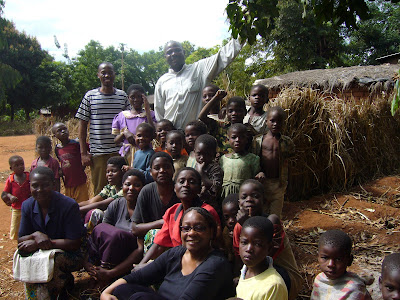
Me (front row, sitting) with villagers from Mambuka where we interviewed a traditonal healer
The traditional healer who we met was very warm and open, and the interview went well. We met his wife and a few of his children. The village was very peaceful and serene. The children are running about playing, and they are always very curious when visitors are present.
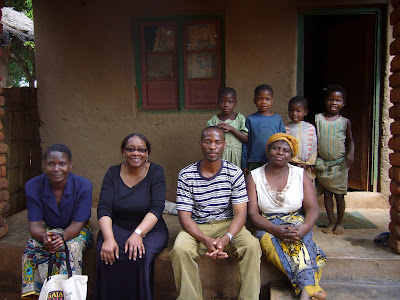
We then went off to Loundu Village to meet another traditional healer. He welcomed us and invited us to enter his house. He was very gracious and permitted us take photos of his traditional medicine collection, which included herbs, leaves, dried roots, and tree bark. I don’t have names of these medicines but some of the names in Chichewa might come out in the interviews. As we waited outside while the interview was conducted in his house, the children gathered looking as if to ask – “who are these strangers?” The scenic views were spectacular, and there was a wonderful sense of calm and peace in the village.
Edna (GAIA coordinator), me, Edgar, and the Chief woman of the village (left to right) with beautiful village children.
Tuesday, July 22, 2008
The Final Stretch
Limbe, Malawi
The research “train” is pulling into the final stretch of our last week here in Malawi. The discussions today with the research team focused on the next steps for the summer and next year for the current project and future projects for which we are awaiting funding. Everyone is busy transcribing interviews from Chichewa into English and then typing the interviews for analysis. We have interviews schedule tomorrow with traditional healers in rural areas.
The time has passed very quickly, but I am thrilled at how productive the data collection has been. We are treading new waters with exploring our sample of traditional healers; the support of the research team with this process has exceeded my expectations!
The research “train” is pulling into the final stretch of our last week here in Malawi. The discussions today with the research team focused on the next steps for the summer and next year for the current project and future projects for which we are awaiting funding. Everyone is busy transcribing interviews from Chichewa into English and then typing the interviews for analysis. We have interviews schedule tomorrow with traditional healers in rural areas.
The time has passed very quickly, but I am thrilled at how productive the data collection has been. We are treading new waters with exploring our sample of traditional healers; the support of the research team with this process has exceeded my expectations!
Monday, July 21, 2008
Eric and Sam
Lilongwe, Malawi
Today is a stay-at-headquarters day dedicated to catching up on paperwork and continuing data analysis. All of the research team members are busy transcribing interviews or typing interviews. We are all either connected to an audio recorder or laptop computer.
The research process is slowing down a little, and we are discussing what will take place when the American team returns to the US and the Malawi team continues with the work.
In the afternoon we are treated to a tour of the Open Arms orphanage. I visited this place in 2004 when I was last in Malawi. The organization accepts children from birth and keeps them for up to two years. Most of the children have lost their mothers, and the goal is to reunite the children with their families in the villages. Most times this works out, but sometimes the children are returned to Open Arms. An outreach program is in place to provide housing and schooling for the orphans who cannot be reunited with their families or adopted.
The care givers are spectacular, and they provide a safe and loving environment for the children to thrive. One way to tell that the children are well loved is that they come up to you with outstretched arms waiting to be picked up. How can anyone resist such an invitation? Once you pick them up, it is very hard to put them down! I was instantly drawn to a little boy named Eric and his twin brother named Sam. I wish I could bring both of them back with me to California. Perhaps another time.
Today is a stay-at-headquarters day dedicated to catching up on paperwork and continuing data analysis. All of the research team members are busy transcribing interviews or typing interviews. We are all either connected to an audio recorder or laptop computer.
The research process is slowing down a little, and we are discussing what will take place when the American team returns to the US and the Malawi team continues with the work.
In the afternoon we are treated to a tour of the Open Arms orphanage. I visited this place in 2004 when I was last in Malawi. The organization accepts children from birth and keeps them for up to two years. Most of the children have lost their mothers, and the goal is to reunite the children with their families in the villages. Most times this works out, but sometimes the children are returned to Open Arms. An outreach program is in place to provide housing and schooling for the orphans who cannot be reunited with their families or adopted.
The care givers are spectacular, and they provide a safe and loving environment for the children to thrive. One way to tell that the children are well loved is that they come up to you with outstretched arms waiting to be picked up. How can anyone resist such an invitation? Once you pick them up, it is very hard to put them down! I was instantly drawn to a little boy named Eric and his twin brother named Sam. I wish I could bring both of them back with me to California. Perhaps another time.
Sunday, July 20, 2008
Off to Church
Chirimba, Limbe, Malawi
This morning we are off to the Presbyterian Church for Sunday morning service. The Malawians are always very gracious when they have guests from America. I sat up in the front area with the pastor, other clergy, and the lay leaders of the church. The service was in English, so it was like attending church in San Francisco. The singing was wonderful and they sang hymns with which I was familiar. A trio of young men sang a couple of selections with taped music, and they were great. After the service we toured the property on which the church is building a new fellowship hall, and they have plans toconstruct a building for the children. This was a prosperous church by Malawi standards, but there is a constant need for resources, mainly money to complete buildings and grounds projects.
The rest of the day was restful, and we planned for the upcoming week. On Wednesday we will go out and try to collect a few more interviews with traditional healers in the rural areas.
I decided in the last week that it would be interesting to collect advertisements from the local news papers placed by traditional healers or people selling herbal products to treat medical conditions, including HIV/AIDS. The process is interesting, and this could be a separate study in itself. So we will see what this activity yields.
This morning we are off to the Presbyterian Church for Sunday morning service. The Malawians are always very gracious when they have guests from America. I sat up in the front area with the pastor, other clergy, and the lay leaders of the church. The service was in English, so it was like attending church in San Francisco. The singing was wonderful and they sang hymns with which I was familiar. A trio of young men sang a couple of selections with taped music, and they were great. After the service we toured the property on which the church is building a new fellowship hall, and they have plans toconstruct a building for the children. This was a prosperous church by Malawi standards, but there is a constant need for resources, mainly money to complete buildings and grounds projects.
The rest of the day was restful, and we planned for the upcoming week. On Wednesday we will go out and try to collect a few more interviews with traditional healers in the rural areas.
I decided in the last week that it would be interesting to collect advertisements from the local news papers placed by traditional healers or people selling herbal products to treat medical conditions, including HIV/AIDS. The process is interesting, and this could be a separate study in itself. So we will see what this activity yields.
Saturday, July 19, 2008
Tracking Expenses
Limbe, Malawi
Today was a low-key day. It’s hard to believe that two weeks have passed, they have very quickly. The data collection process has gone well. I might get a few more interviews with traditional healers next week. I worked on budget issues keeping my Excel spread sheet up to date with the grant expenses. Tomorrow I will be attending a Presbyterian Church service with our friend Alice Bivumbe who is the Global Aids Interfaith Alliance (GAIA) project director for the southern region of Malawi.
Friday, July 18, 2008
Breakfast at the Ritz
Lilongwe, Limbe, Malawi
The day began with a beautiful English breakfast at Wendel’s, a small piece of paradise tucked away in Lilongwe, and my favorite place to stay in Malawi. We call this place the “Ritz” of Malawi.
After breakfast, we went to Kamuzu College of Nursing to meet with the dean of faculties. She took us on a tour of David Livingstone’s Memorial Clinic, which is run by nursing faculty members. There is a an antenatal clinic, a birthing ward for non-complicated births (However they deliver breech babies, multiple births, vacuum extractions, etc..), an outpatient post-partum clinic, an under-5-years-old clinic, and a primary care clinic for male and female adults. The facilities are beautiful with nice beds, pretty room décor, showers, etc. They are the best I’ve seen in Malawi.
We then went off to see the pediatric HIV clinic, which is part of the Baylor School of Medicine initiative. The facility is 2 years old, and is absolutely gorgeous. I visited the pharmacy and saw a pharmacist providing medication counseling to a mother. During our visit, we saw two pediatricians who completed their pediatric residency training at UCSF, and they were happy to see me and my colleague Ellen. They have been in Malawi for a year working at the clinic.
As we journeyed back to Limbe, we passed several outdoor markets because Friday is “Market Day”. There are crowds of people selling fruits, vegetables, and clothing – lots of stuff. I must say that the fruits and vegetables looked beautiful. It’s all organic! The tomatoes are a rich red and the carrots are bright orange. They had lovely eggplants, onions, peas, green beans – just about anything you could want. Our driver got out, making a few purchases, and I stayed in the car. A mob of people, hoping we would buy something, swarmed the car offering what they had. I was afraid to step out of the car because I did not know how to choose which seller.
The day began with a beautiful English breakfast at Wendel’s, a small piece of paradise tucked away in Lilongwe, and my favorite place to stay in Malawi. We call this place the “Ritz” of Malawi.
After breakfast, we went to Kamuzu College of Nursing to meet with the dean of faculties. She took us on a tour of David Livingstone’s Memorial Clinic, which is run by nursing faculty members. There is a an antenatal clinic, a birthing ward for non-complicated births (However they deliver breech babies, multiple births, vacuum extractions, etc..), an outpatient post-partum clinic, an under-5-years-old clinic, and a primary care clinic for male and female adults. The facilities are beautiful with nice beds, pretty room décor, showers, etc. They are the best I’ve seen in Malawi.
We then went off to see the pediatric HIV clinic, which is part of the Baylor School of Medicine initiative. The facility is 2 years old, and is absolutely gorgeous. I visited the pharmacy and saw a pharmacist providing medication counseling to a mother. During our visit, we saw two pediatricians who completed their pediatric residency training at UCSF, and they were happy to see me and my colleague Ellen. They have been in Malawi for a year working at the clinic.
As we journeyed back to Limbe, we passed several outdoor markets because Friday is “Market Day”. There are crowds of people selling fruits, vegetables, and clothing – lots of stuff. I must say that the fruits and vegetables looked beautiful. It’s all organic! The tomatoes are a rich red and the carrots are bright orange. They had lovely eggplants, onions, peas, green beans – just about anything you could want. Our driver got out, making a few purchases, and I stayed in the car. A mob of people, hoping we would buy something, swarmed the car offering what they had. I was afraid to step out of the car because I did not know how to choose which seller.
Thursday, July 17, 2008
Graduation at Kamuzu College of Nursing
Lilongwe, Malawi
Today I took a side trip to Lilongwe to attend a ceremony for entering nursing students who have received GAIA scholarships at Kamuzu College of Nursing. Being a GAIA Board member, I was happy to attend. The ceremony was beautiful. The young women are all smiles and excited about their new academic journey. The country of Malawi is in desperate need of nurses and all other medical personnel. This is a great way to assist young women who would otherwise not be able to attend nursing school due to lack of funds. The scholarship is for 4 years and the students sign a contract to stay in the country at least for 4 years after graduation.
Lots of important government people attended. The Minister of Health for Malawi was there along with his office; the Vice Chancellor of Kamuzu College attended as well. The auditorium was packed. GAIA President Dr. Bill Rankin gave a few remarks. It was truly beautiful. The Malawi press was present and there was some interviewing and picture taking. There was a reception afterwards - a truly heart warming and significant event.
Not much research done today, but it is because of my association with GAIA that I was successful in getting the grant to conduct my project. Tomorrow we return to Limbe.
Today I took a side trip to Lilongwe to attend a ceremony for entering nursing students who have received GAIA scholarships at Kamuzu College of Nursing. Being a GAIA Board member, I was happy to attend. The ceremony was beautiful. The young women are all smiles and excited about their new academic journey. The country of Malawi is in desperate need of nurses and all other medical personnel. This is a great way to assist young women who would otherwise not be able to attend nursing school due to lack of funds. The scholarship is for 4 years and the students sign a contract to stay in the country at least for 4 years after graduation.
Lots of important government people attended. The Minister of Health for Malawi was there along with his office; the Vice Chancellor of Kamuzu College attended as well. The auditorium was packed. GAIA President Dr. Bill Rankin gave a few remarks. It was truly beautiful. The Malawi press was present and there was some interviewing and picture taking. There was a reception afterwards - a truly heart warming and significant event.
Not much research done today, but it is because of my association with GAIA that I was successful in getting the grant to conduct my project. Tomorrow we return to Limbe.
Wednesday, July 16, 2008
A Gift of Song
Zomba, Malawi
We went to Zomba, and the team interviewed people living with HIV/AIDS. This group is part of my study. I am interested in how their church is helping them access ARVs, if they have consulted a traditional healer for medicines to treat HIV/AIDS, and the barriers they have experienced accessing ARVs.
These villages are also ones that have benefited from Global Aids Interfaith Alliance (GAIA) projects, which include: home-based care for people who are HIV positive or people who are caring for HIV positive family members or friends, orphan care, support for secondary school fees, and income generating activities for the women of the village.
We met a group of women who started a mushroom farm in the village and are now planting maize (corn) to sell for income. Thus far the projects have made good profits, and they want to continue. There were a few of us who asked questions, so it was like a town hall meeting of sorts, run by the women of the village. It was exciting to see the exchange of ideas and the discourse that occurred over the logistics of the projects and the logical next steps. As with all businesses, not everyone involved agrees on each step of the process or in what ways to move forward, so the challenge is to figure out some sort of compromise. A small village in Malawi or a corporate office in San Francisco, the human conflict is the same!
The trip back to Limbe is reflective and quite bumpy. Life in these small townships and villages is so different to what I’m use to in my day-to-day life in San Francisco. The people in Malawi have very little, but they manage to do the best they can.
I end today with the image of the village women singing to us as we left the village. I did not understand the words, but the rhythm was fun and I could clap with them as we walked down the road. It was translated to me to mean “have a safe journey and God Bless you”. How generous of them to leave us with such a gift of song!
We went to Zomba, and the team interviewed people living with HIV/AIDS. This group is part of my study. I am interested in how their church is helping them access ARVs, if they have consulted a traditional healer for medicines to treat HIV/AIDS, and the barriers they have experienced accessing ARVs.
These villages are also ones that have benefited from Global Aids Interfaith Alliance (GAIA) projects, which include: home-based care for people who are HIV positive or people who are caring for HIV positive family members or friends, orphan care, support for secondary school fees, and income generating activities for the women of the village.
We met a group of women who started a mushroom farm in the village and are now planting maize (corn) to sell for income. Thus far the projects have made good profits, and they want to continue. There were a few of us who asked questions, so it was like a town hall meeting of sorts, run by the women of the village. It was exciting to see the exchange of ideas and the discourse that occurred over the logistics of the projects and the logical next steps. As with all businesses, not everyone involved agrees on each step of the process or in what ways to move forward, so the challenge is to figure out some sort of compromise. A small village in Malawi or a corporate office in San Francisco, the human conflict is the same!
The trip back to Limbe is reflective and quite bumpy. Life in these small townships and villages is so different to what I’m use to in my day-to-day life in San Francisco. The people in Malawi have very little, but they manage to do the best they can.
I end today with the image of the village women singing to us as we left the village. I did not understand the words, but the rhythm was fun and I could clap with them as we walked down the road. It was translated to me to mean “have a safe journey and God Bless you”. How generous of them to leave us with such a gift of song!
Subscribe to:
Posts (Atom)